
English
Please Choose Your Language
Views: 0 Author: Site Editor Publish Time: 2026-10-29 Origin: Site


You want the best for your newborn, and the right diaper starts with a few clear features. Look for fragrance-free and dye-free materials, a soft, hypoallergenic topsheet, all-around breathability, a high-absorbency core, a snug fit, and third-party certifications like OEKO-TEX.
Here is the catch: "hypoallergenic" is not a regulated standard. Any brand can print the word on a package. The features themselves are your real guide when you shop for hypoallergenic newborn diapers.
Use this list with confidence. You can judge hypoallergenic newborn diapers by what you can verify, not by what the label promises.
Don't trust the 'hypoallergenic' label, because no agency controls it. Instead, look for materials that are free of fragrance and dye.
Pick a diaper with a soft top layer, a breathable back layer, and a core that absorbs a lot. This helps keep your baby's skin dry and calm.
Check for third-party certifications, such as OEKO-TEX Standard 100 Class I. These show that the diaper is safe for sensitive skin.
Make sure the diaper fits snugly with leg cuffs and a stretchy waistband. Red marks mean it is too tight, and gaps mean it is too loose.
Change your newborn's diaper about every two hours. Also give them diaper-free time each day to prevent irritation.
The word sounds official, but it is not. No government agency checks or approves the term "hypoallergenic" for diapers. A brand can print it on any package without proving a single claim. That fact surprises many parents.
So how do you judge a diaper? You look at what the maker can verify. Materials, construction, and test results tell you far more than a front-label promise. A diaper earns the description through its design, not its wording.
This matters most in the early weeks. Your baby's skin is adjusting to everything, and a diaper sits against it around the clock. A vague claim gives you nothing to check. A listed material or a named certification gives you something solid.
Several key diaper features deserve your attention. Each one plays a distinct role in comfort and skin health.
Start with materials. The topsheet touches your baby all day, so softness and low allergen risk matter. The absorbent core controls wetness. Breathability manages heat and sweat. Fit keeps leaks and friction in check. Certifications confirm that an independent party checked the claims.
Topsheet fabrics differ in real ways. Spunbond polypropylene offers medium softness at low cost. Thermal bond nonwoven feels softer and stays drier. Spunlace nonwoven ranks highest on softness, with very low allergen risk and a higher price. A hypoallergenic baby diapers topsheet should also be free of latex, formaldehyde, and heavy metals.
Core design follows a similar logic. Fluff pulp wicks well and costs little, but it clumps when wet. Super absorbent polymer (SAP) absorbs up to about 300 times its weight and holds fluid under pressure. Pure SAP cores stay rare because of cost and gel-blocking risk. Most premium diapers blend the two, typically 50:50 to 70:30 fluff to SAP. That mix supports a high absorbency core just 2–3 mm thin.
The American Academy of Pediatrics advises avoiding fragrances and dyes. Keep that guidance in mind as you read labels.
You now have the frame. The sections ahead unpack each feature in turn, so you can weigh them with confidence.
Newborn skin is different from adult skin in ways you can measure. The outer layer is thinner, and the barrier is not fully grown. Research shows the epidermis is thinner by up to 20%, and the stratum corneum is thinner by up to 30%. Some studies argue about the exact gap, but the overall picture stays the same: the barrier is still maturing.
Variable | Newborn/Infant vs Adult |
|---|---|
Epidermal thickness | Thinner by up to 20% |
Stratum corneum thickness | Thinner by up to 30% |
Keratinocyte size | Smaller |
Corneocyte size | Smaller |
Cell turnover | Faster |
A thinner barrier lets irritants reach deeper layers more easily. Cell attachments are also less developed, and the dermoepidermal junction is flat instead of wavy. Lipids and melanin are lower too. These traits make sensitive baby skin react faster to the same conditions an adult would shrug off. Gentler diapers help by reducing the load on that barrier.
Four triggers cause most diaper-related irritation. Moisture softens the skin and raises friction. Friction wears on the surface during movement and repeated changes. Fragrance and dyes add contact exposure for sensitive skin. None of these is dangerous on its own, and each one is easy to manage.
Watch how these triggers combine. A wet diaper plus rubbing plus a scented wipe creates a bigger challenge than any single factor. Your newborn's skin faces that mix many times a day. A fragrance-free, dye-free diaper removes two triggers at once. Frequent changes and a breathable design address the rest. Pay attention to your baby's skin and adjust as needed.
Materials are your first line of defense for sensitive baby skin. The American Academy of Dermatology says fragrance and dyes are common irritants. These ingredients can cause diaper rash, redness, or allergic reactions. Mayo Clinic guidance adds a useful warning: even "mildly scented" products can hide allergens. Choose diapers labeled hypoallergenic & fragrance-free, and read the fine print.
A truly fragrance-free diaper has no added scent at all. The "baby smell" is marketing, and fragrance formulas can hide hundreds of undisclosed ingredients, including phthalates. The Environmental Working Group always flags fragrance as something to avoid in products that sit on skin for long periods. Added lotions deserve the same scrutiny. They often cover odors from cheaper materials, and they serve no real purpose. For a newborn with rash-prone skin, a lotion-free design is the kinder choice.
Look for diapers that are dye-free and free of fragrance and allergens. Third-party seals such as OEKO-TEX Standard 100, EWG Verified, and the Dermatest Excellence Seal give you a verifiable way to confirm these claims. Brands like Tianjiao list fragrance-free, dye-free, and chlorine-free features on their packaging, which shows how these standards look in practice. Most diaper rash is not random. Excess moisture and harsh chemicals usually drive it, so removing fragrance and dyes addresses a root cause.
Bleaching methods matter too. Conventional chlorine bleaching can leave trace dioxins behind. Elemental Chlorine Free (ECF) and Totally Chlorine Free (TCF) methods minimize those residues. Latex is another common allergen, so a latex-free build lowers allergy triggers for sensitive babies. Paraben-free construction follows the same logic. Together these choices keep clean and gentle ingredients against your baby's skin.
Plant-based fibers and sustainable pulp offer a gentle path as well. Breathable backsheets made from plant-based materials help keep skin dry and reduce rash risk. A 100% cotton topsheet keeps plastic away from your baby's skin entirely, which suits parents who prefer natural fibers. Each option fits a different priority. Cotton favors natural materials, while plant-based nonwovens balance softness and cost.
Whatever you choose, confirm the diaper is no fragrance, lotion, or latex. A gentle topsheet material should also be free of formaldehyde and heavy metals. These details separate genuine hypoallergenic materials from label hype. General safety guidance notes that contact dermatitis affects nearly half of infants in the first 12 months, so these choices carry real weight for your newborn. A non-irritating diaper starts with materials you can verify, and hypoallergenic newborn diapers earn that name through construction, not claims.
A diaper wraps your baby in layers, and those layers hold in heat and wetness. A leak-proof disposable makes a very warm, damp space inside. That closed-in space is exactly where bacteria and yeast grow well. Too much moisture also softens the skin and makes diaper rash more likely.
Airflow changes that. Breathable materials let warm, damp air escape instead of building up against your baby's skin. Natural-fiber cloth lets air move in a way a plastic outer layer cannot. Breathability alone will not stop every rash, but it removes one big condition that rashes need.
Diaper Type | Breathability | Moisture Handling |
|---|---|---|
Natural-fiber cloth (cotton, bamboo, hemp) | Lets air move in a way plastic cannot | No gel core, so change right away |
Disposable (polymer plus plastic outer layer) | Plastic outer layer does not breathe | Polymer pulls moisture into a gel |
Breathability is found in certain parts of the diaper. The backsheet is the outer layer, and a breathable one lets vapor pass through while still holding liquid in. The waistband rests against skin for hours, so a breathable waistband cuts down sweat buildup at the belly. The topsheet touches your baby directly, and an airy fabric there keeps the surface feeling drier.
You can check these features on the package. Look for terms like "breathable backsheet" or "airflow waistband." Manufacturers such as Tianjiao list breathable materials among their design features, which shows how brands share this information. Pair breathable baby diapers with frequent changes, about every two hours, because every absorbent core has a limit. For your newborn, short diaper-free periods of two to three hours a day give the skin a real break from moisture.
A high-absorbency core works like a sponge with a memory. Superabsorbent polymer (SAP) sits at the center, and it pulls liquid in and locks it away. The steps happen fast:
Water enters the polymer granule surface through capillary action.
Sodium ions break away, and the charged groups left behind attract water molecules.
An ion concentration gradient draws more water inward.
Chemical crosslinks stop the gel from dissolving, so it swells until elastic resistance balances the pull.
The water stays trapped as a semi-solid gel, which keeps the surface dry.
The core holds different liquids at different rates. SAP absorbs up to 300 times its own weight in pure water, about 100 times in tap water, and typically 50–70 times in human urine. That last figure is the one that matters for your newborn.
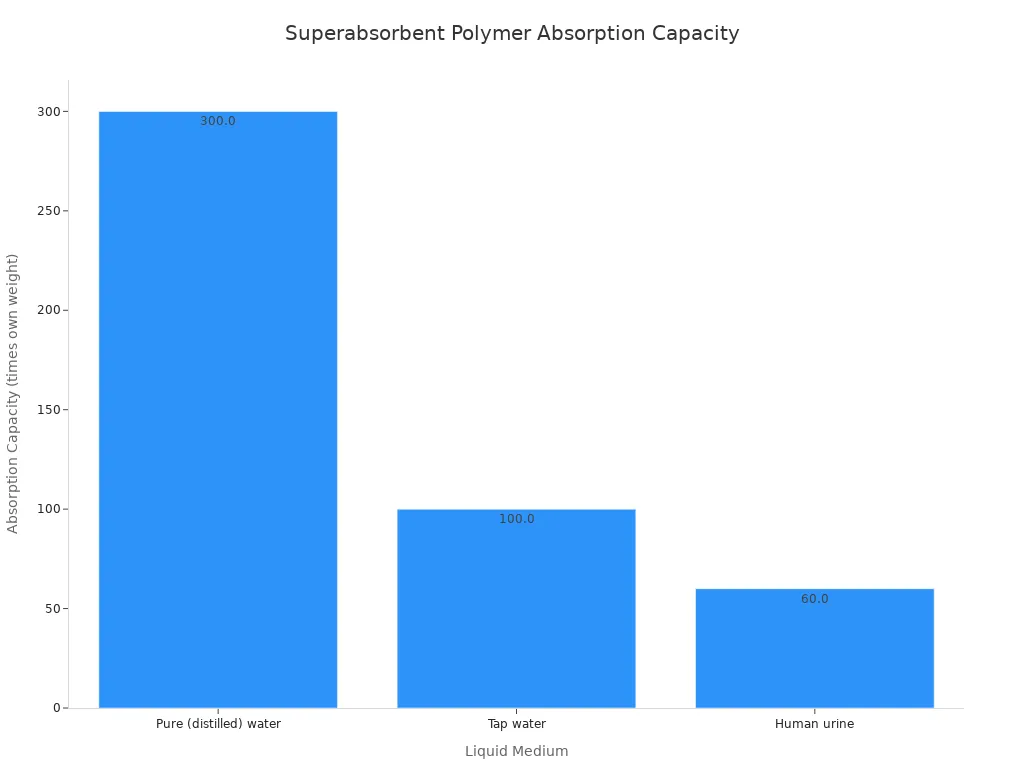
Fluff pulp spreads liquid through the core, and SAP holds it under body pressure. This balance controls rewet, so wetness stays away from your baby's skin. Tianjiao lists core design among its manufacturing features, which shows how brands present this engineering.
More absorbency usually means more material, and more material means bulk. A thick diaper can feel heavy and restrict movement. A very thin one may need more frequent changes. For a newborn, the middle path works best. A high absorbency core of 2–3 mm can handle several wettings when the fluff-to-SAP ratio is right.
Watch for gel blocking. Too much SAP and too little pulp can slow liquid intake, so wetness sits on the surface. A balanced blend keeps intake fast and absorption even. Judge a diaper by how dry the surface feels after a wetting, not by its thickness.
Good fit starts at the edges. Snug leg cuffs form a soft seal around each thigh. A flexible waistband moves with your baby instead of digging in. Together they create a secure, stretchable fit that holds wetness inside and keeps fabric from rubbing.
Watch for the common fit failures. A diaper that is too large leaves gaps around the legs, and urine escapes through them. A diaper that is too small presses on the waist and thighs, which causes red marks and irritation. Persistent leaks often signal the wrong size in either direction. Check the cuffs after each change. The elastic should sit close to the body without leaving deep lines.
Most brands size the newborn diaper for babies up to 10 pounds. Pampers, Huggies, Luvs, and typical store brands all follow this range. Size 1 then covers 8 to 14 pounds, so the two sizes overlap. That overlap gives you room to switch when the fit tells you to.
Size | Weight Range |
|---|---|
Preemie | Up to 6 lbs |
Newborn | Up to 10 lbs |
Size 1 | 8 to 14 lbs |
Size 2 | 12 to 18 lbs |
Use weight as a starting point, not a rule. Check for a newborn notch, the small cutout some brands add at the front to protect the umbilical cord stump. Look for three signs of a poor fit:
Red marks on the waist or legs mean the diaper is too tight.
Gaps at the leg openings mean it is too loose.
Repeated blowouts mean the coverage is too small.
A secure, gentle fit leaves no deep marks and no leaks. Your baby's skin stays calm, and you change with confidence.
A third-party certificate gives you something a label claim cannot: proof that an independent lab ran the tests. OEKO-TEX STANDARD 100 confirms that a finished textile article has been tested for harmful substances and found safe for human health. Diapers fall under Class I, the strictest class in the system, which covers products for babies and children up to 3 years.
The testing goes deep. Every component is checked, from fabric and sewing threads to zips, prints, and coatings. If one component fails, the whole article fails. The lab screens against a criteria catalogue of more than 1,000 harmful substances, including banned azo dyes, formaldehyde, heavy metals, pesticide residues, chlorinated phenols, phthalates, pH value, and color fastness. Limit values align with regulations such as REACH, CPSIA, and the ECHA-SVHC candidate list.
Know the limits of the seal. OEKO-TEX does not verify organic fiber content, and it does not audit factory ethics. A certificate stays valid for one year, requires retesting at renewal, and covers only the specific article and production site named on the document. EWG Verified works as a useful companion seal, since it screens more than 4,000 chemicals and requires full disclosure. Brands like Tianjiao list these seals on their packaging, which shows how the standards look in practice.
There are no strict labeling requirements defining which chemicals or additives qualify for a "hypoallergenic" label, so each diaper brand determines for itself whether its diapers are hypoallergenic. This means label claims alone are insufficient—consumers should verify via ingredient disclosure, independent certifications, and testing documentation.
Read the label with that gap in mind. Look for a complete ingredient list that names adhesives, elastic components, and processing chemicals. Treat vague terms like "plant-based" or "natural" as incomplete until the brand supplies specifics. Check for red-flag ingredients: synthetic fragrances, chlorine dioxide bleaching residues, latex, parabens, phthalates, and dyes. Ask for dermatological testing documentation, such as a third-party patch test with 200 or more participants over 48 to 72 hours, screening for 26 contact allergens. These steps let you judge hypoallergenic newborn diapers on evidence, and they keep your newborn's skin the priority.
Use this table as a fast guide when you compare packages. Each row names a key diaper feature and the detail to confirm on the label or product page.
Feature | What to Confirm |
|---|---|
Materials | Fragrance-free, dye-free, lotion-free, latex-free |
Topsheet | Soft, hypoallergenic, free of formaldehyde and heavy metals |
Breathability | Breathable backsheet and airflow waistband |
Core | A high absorbency core with a balanced fluff-to-SAP blend |
Fit | Snug leg cuffs, flexible waistband, no red marks |
Certifications | OEKO-TEX Standard 100 Class I, EWG Verified |
Newborn details | A newborn notch for the umbilical cord stump |
Print the list or save it on your phone. A quick scan of these rows tells you whether a package deserves a closer look.
Price per diaper is one number, and it never tells the whole story. Compare options on technical performance, fit, regulatory compliance, and cost together. Absorption speed, leak capacity, and surface dryness show how well a diaper manages moisture. Fit shows whether it stays snug without digging or gapping. Certifications show whether an independent lab checked the materials.
Ease of use and a wetness indicator also count, especially for nighttime changes. A higher price does not always mean better performance, so weigh each metric against your own routine. Tianjiao publishes its manufacturing and testing details, which gives you a starting point for side-by-side comparison. The best baby diapers for sensitive skin earn that place through verified features, not price tags. Apply the same checklist to every brand, and let the evidence guide your choice among hypoallergenic newborn diapers.
Good habits matter as much as good materials. Change your newborn's diaper about every two hours, and sooner after a bowel movement. A wet diaper left in place softens the skin and raises friction. Frequent changes remove moisture before it can do harm. Nighttime deserves attention too. Check for wetness during feeds, and change your baby if the diaper feels heavy.
Short diaper-free periods give sensitive skin a real break. Aim for two to three hours a day, spread across several sessions. Place your baby on a waterproof mat or a clean towel. Let the area air-dry fully before you fasten a fresh diaper. This routine supports skin safety by cutting moisture exposure. Watch your baby's mood during these sessions. Most newborns enjoy the freedom, and you get an easy window for gentle observation.
Know what mild irritation looks like. Redness in the diaper area, small raised bumps, or fussiness during changes can signal trouble. These signs often fade with more frequent changes and a fragrance-free routine. Check the folds of the legs and the waistband line, since friction shows up there first. Note any pattern tied to a new wipe, diaper brand, or detergent.
Some situations call for a pediatrician. Contact your doctor if a diaper rash persists beyond a few days, spreads, blisters, or oozes. The same applies when your baby runs a fever or seems uncomfortable despite your care. Persistent rashes can point to a yeast infection or an allergy that needs proper treatment. Keep the tone calm here. Most irritation clears quickly with simple adjustments. Your baby's skin tells you what it needs, and you now know how to read the signs.
You now have a clear picture of what matters. Look for fragrance-free and dye-free materials, a soft hypoallergenic topsheet, all-around breathability, a high-absorbency core, and a snug fit. Third-party certifications confirm these features with independent testing. Keep the checklist handy on your next shopping trip. Compare each option against it, and let verified details guide your choice for your newborn. Most minor irritation clears with frequent changes and gentler materials. If a diaper rash persists, spreads, or worries you, call your pediatrician. You have the knowledge to choose well. Trust the checklist, watch your baby's skin, and shop with confidence.
No. No agency regulates that word for diapers, so any brand can print it. Judge the diaper by what you can check instead: a fragrance-free and dye-free build, a soft topsheet, breathable layers, and a named certification such as OEKO-TEX Standard 100 Class I.
OEKO-TEX Standard 100 Class I is a strong signal. It covers products for babies up to 3 years and tests every component against a catalogue of more than 1,000 harmful substances. EWG Verified works well as a companion seal. Check that the certificate names the exact product and production site.
Change your newborn about every two hours, and sooner after a bowel movement. Every core has a limit, even a high-absorbency one. Add short diaper-free periods of two to three hours a day to give the skin a break from moisture.
Most brands size newborn diapers for babies up to 10 pounds, and Size 1 starts around 8 pounds. Treat weight as a starting point. Red marks mean the diaper is too tight, gaps at the legs mean it is too loose, and repeated blowouts mean the coverage is too small.
Yes. Natural fibers feel gentle, but moisture and friction still trigger irritation when a wet diaper stays in place. A cotton topsheet keeps plastic off the skin, and plant-based backsheets breathe well. Pair either option with frequent changes and a fragrance-free routine.